Ten years ago, I had a Big Plan. I had begun weaving twill tapestries on a 4-shaft floor loom. I liked weaving these tapestries and wanted to make a little industry of them. At the time, I had a little studio downtown to teach in and kept my loom there.
The teaching fizzled out and I couldn’t keep up the rent. The stairs going up to the studio and the loom pedals started giving me trouble too, so I decided to regroup, take my things back home and work in my little origami jigsaw puzzle studio (9 x 10—not much room for a floor loom, work table, desk….you get the idea). I continued to have issues with the loom pedals and eventually switched to a Louet Jane 8-shaft table loom with stand. I loved my Jane. Still do. It’s a beautifully engineered loom and easy to weave on. I was set. Big Plan version 2.
I warped the loom with some 8/2 cotton to weave towels thinking this was a good way to break in the loom before I started weaving tapestries. I got bored with the towels. Don’t get me wrong. I love seeing the amazing things others weave—towels, scarves, shawls—but that isn’t where my head and hands want to go. I had half the warp still to go and decided it was time to cut off the towels and start weaving a tapestry. I started work on Dream Walking.
I love this tapestry. The colors. The flow of the weave structure in the design. But it was SLOW. If any of you have woven tapestries, you know that it is a slow process. Coiled basketry is slow. But this was SLOW. It took me an hour and a half to weave one row. One row. That is SLOW.
The twill is woven on opposites—one row of design then one row of the background and when I did the background row I had to move all the of the different yarn bundles out of the way toward the unwoven warp to get the background row tamped in. I devised a clothesline sort of thing to hold all my bobbins out of the way and then there was keeping the tension on all those yarn bundles even while I placed the background row in place….. It was really hard to get much flow going with all the fiddling.
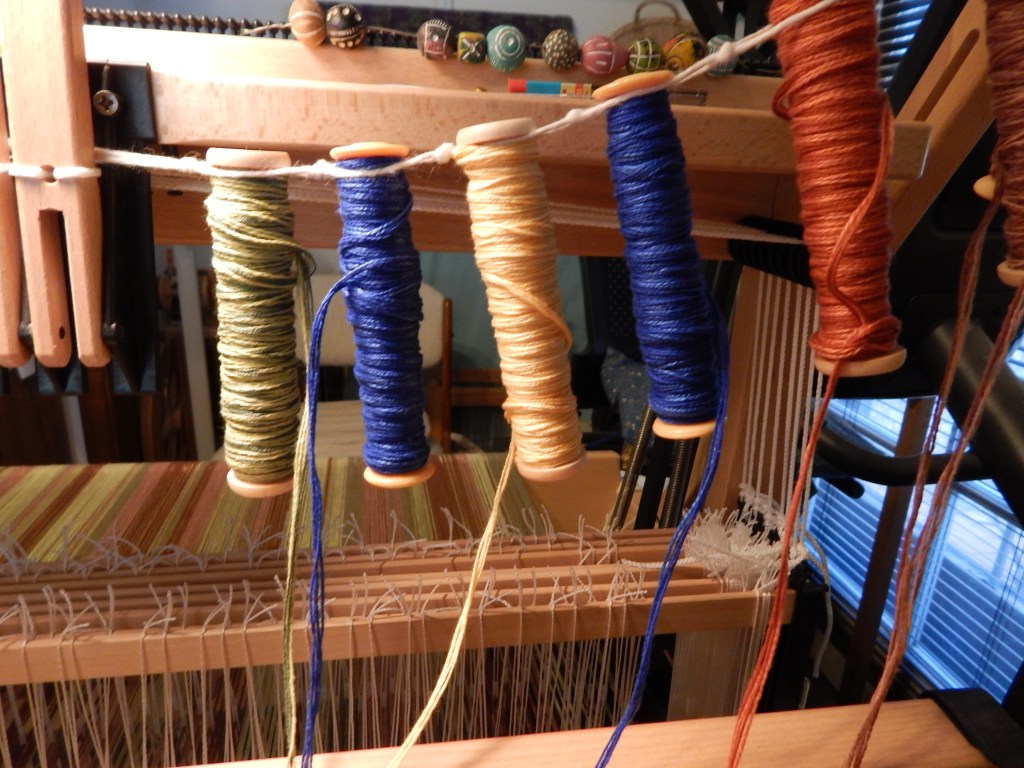
So, Dream Walking has been sitting on my loom unfinished while I thought about what I wanted to do. It’s been there for years. And I’ve been squeezing past the loom to get to my yarn cabinet or to my ‘thinking’ chair. This room is a mess. An origami jigsaw puzzle too tight to unfold.
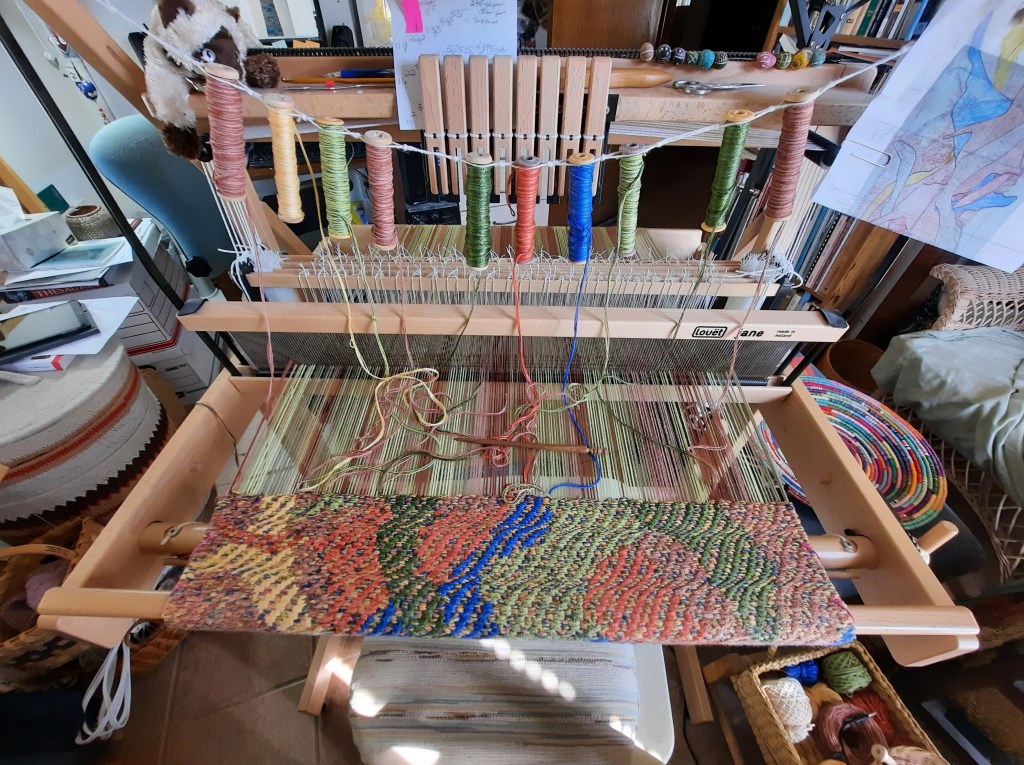
And I realized as I did a number of little tapestries on frame looms, it wasn’t just the SLOW, it was feeling of the work itself. I could only see a fraction of the weaving. I couldn’t feel the work. It didn’t flow. A lot of this came to me as I worked on my color journaling book last year. I came to realize that all of the issues with this style of weaving weren’t just technical; they were fundamental issues with the way my creativity works.
I need to be immediately connected with the fibers in my hands manipulating them directly. And because my work is improvisational, even when I have a design, I’m winging it and changing things as I go. Shuttles and shafts and rolling the warp just don’t work for me. I need to see the work—all of it—and I need to feel what I’m doing.
So, it’s time to let the BIG PLAN go. Ten years have passed since I had that studio. Eight years since I got the table loom. I am in my late 60s not my late 50s. I have a lot of things I still want to do, and I need the space and the peace of mind to work on them. It made me a bit sad to cut Dream Walking off the loom half-finished because I still love the way it looks, but I don’t love the way I have to work to make it happen. I’m not ready to give up Jane yet. I will put her in storage for now.
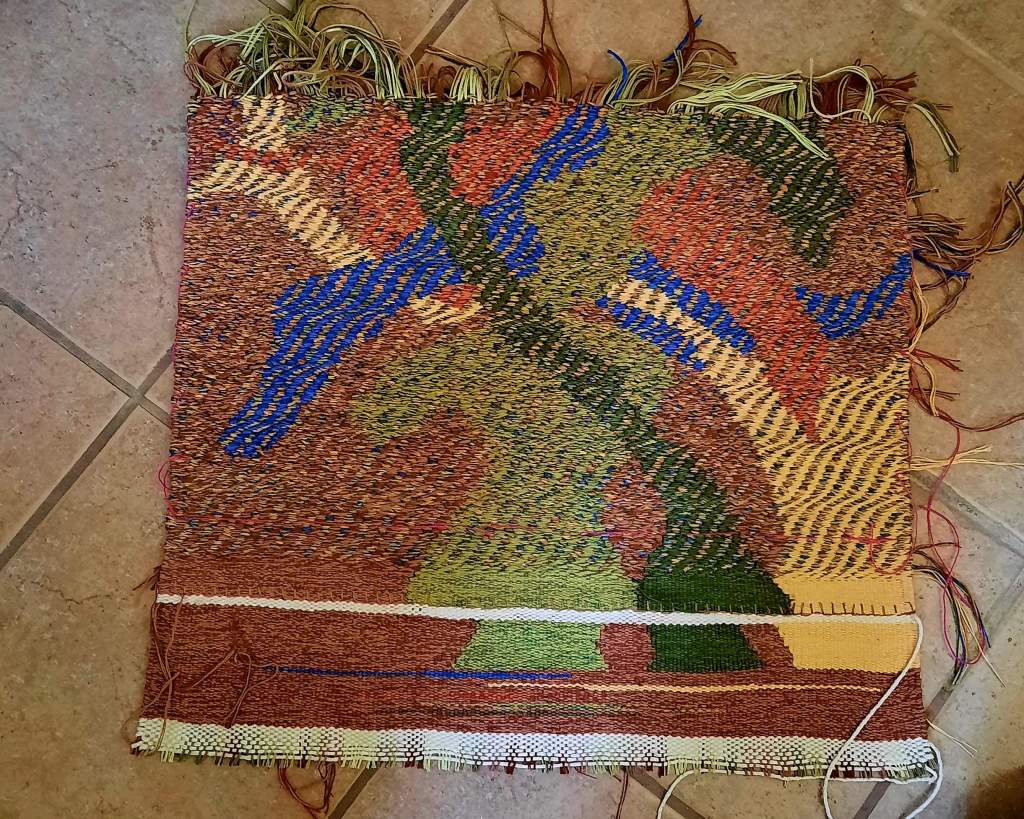
What have I learned from all of this? Not all my creative ideas are a good fit. Focusing on process is such an important part of how my creativity works that I can’t ignore it or sidestep it even if in service of what may be a wonderful piece of weaving. I have learned a lot in the last 10 years about how my creativity works and what I need to do to keep it growing and flourishing.
Will I return to Dream Walking? I’m pretty sure I will but I will do it in a different way. And next time, I will weave from the back so that I leave the bobbins below the shed rather than trying to contain them over the open warp threads*. That should help with the time factor. I will still use a twill structure for it but will weave it freehand.
When will I return to Dream Walking? I’m not sure. I’m busy working on some tutorials and workbooks to start teaching my coiled basketry techniques again. I won’t be able to teach in person, so I’m going to build something online.**
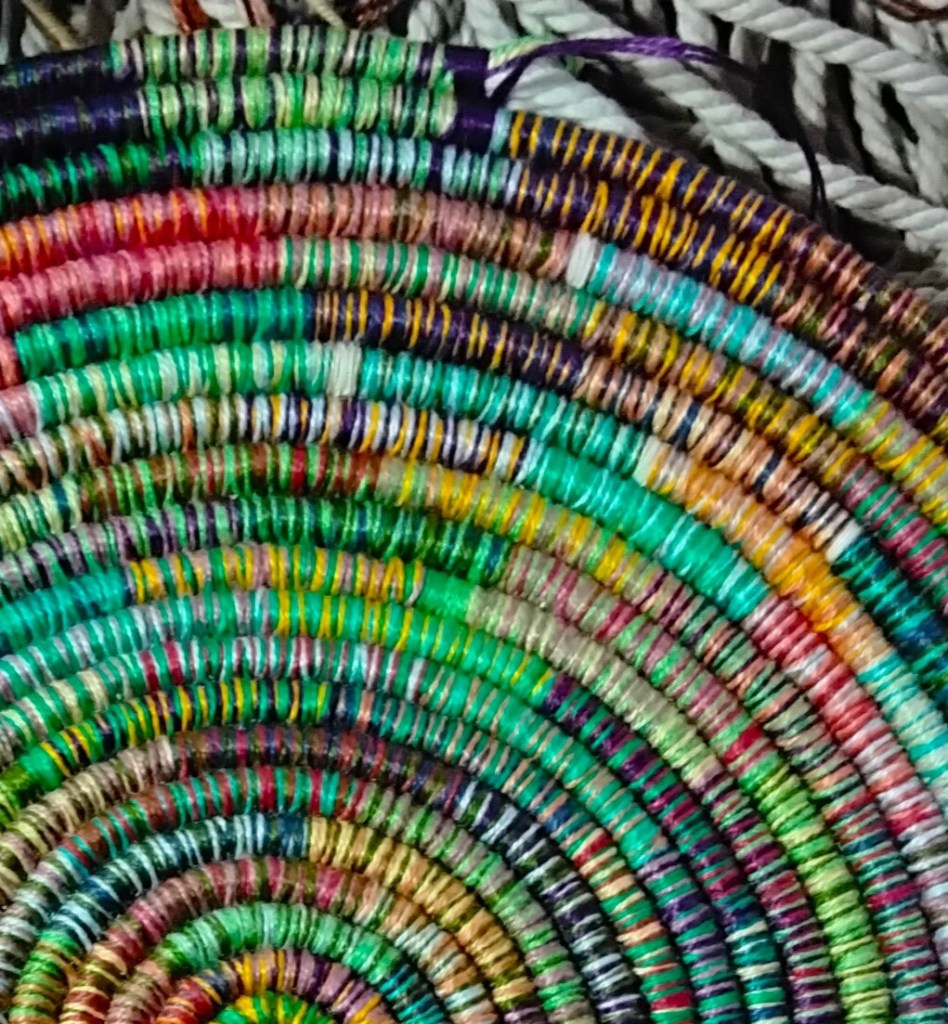
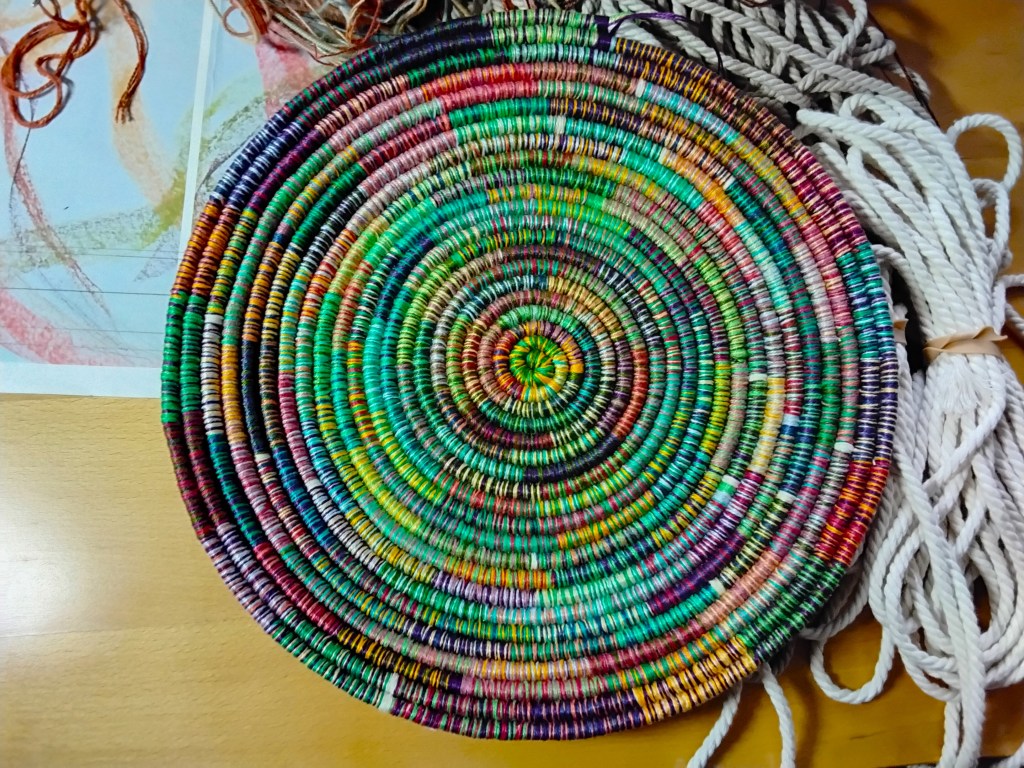
I’m also continuing my 3rd Coiling Chronicle. I have 7 months done, 5 to go. There are fewer white marks here because I changed the rules last year. If I choose my colors for the day but don’t stitch its section, I just do it the next day. I have been as much as 10 days behind at a time but always manage to catch up at some point. Part of my brain still screams that I’m cheating but I try to ignore it. I wrote more about this on my Substack earlier this month.
My book is now available as an ebook for those of you who are not in the US or prefer ebooks. You can find both versions wherever books are sold. You can also order a copy of the print version here on my website.
Do you have a UFO—unfinished object—in your closet somewhere? Or on your loom? Do you have some creative something you started and have left because you got stuck or just don’t feel it anymore? Don’t feel guilty. There is a reason you haven’t finished it. Was there a design issue? Or is it a technical issue? Or were you beguiled by an idea and it just hasn’t panned out? Take a little time and think about what your intentions were when you started it, why you wanted to do it and then what part of doing it didn’t work for you. There is no such thing as failure when you are creating; only things that we are meant to learn. I learned that weaving on a shaft loom didn’t work for me as well as weaving on a more fundamental frame loom. What will your UFOs teach you?
*Weaving from the back or front are different ways of weaving tapestry that have different technical benefits and issues. I learned about weaving from the back when I read Woven Tapestry Techniques by Archie Brennan and Susan Martin Maffei.
** If you’re interested in my coiled basketry work and would like to learn more, please subscribe to my studio blog on my website.


